

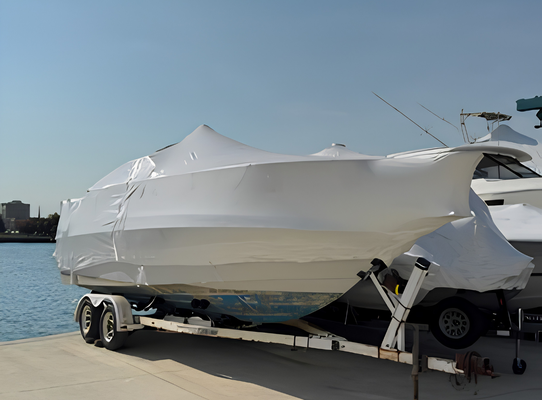
Everybody hauls out around the same few weeks in October, and most people decide where the boat is going about four days beforehand. It’s worth more thought than that. What you pick determines what the boat looks like in May.
The lake is already telling you it’s over. Water temp is dropping, the wind has more teeth in it, and the slips at Simmons Island are emptying out a few boats a week. Somebody at the fuel dock asks what you’re doing with yours this year and you say what you said last year, because it’s what you did last year.
So here’s what each option actually does to a boat over a Wisconsin winter.
What shrink-wrap is good at
Done right, it works. A tight wrap with a proper frame underneath sheds snow, keeps the rain and the ice out of the cockpit, and holds up through a February that dumps on you. It’s the cheaper option by a wide margin. Depending on length and how much rigging has to be framed around, wrapping usually runs somewhere in the neighborhood of twelve to twenty dollars a foot, so a 24-footer lands in the three to five hundred range in most of this market.
The catch is the two words at the front. Done right.
A bad wrap is worse than leaving the boat uncovered. If the installer skimps on the frame, snow load pools in the low spots and the plastic sits down on your canvas and your rails. If it isn’t vented, and a lot of cheap jobs are barely vented, the boat sweats all winter under there. Warm afternoon, cold night, moisture condenses on the inside of the plastic and drips right back down onto your seats. Come spring you pull the wrap off and find mildew up the vinyl and a damp smell in the cabin that takes weeks to chase out.
Mice are the other thing. Shrink-wrap makes a warm, dry, quiet place out of the weather, which is exactly what a mouse is shopping for in November. They come up the lines and the trailer tongue, and once they’re in they get into the wiring and nest in the seat foam. We’ve opened up boats in April where somebody had chewed through half the harness behind the helm.
What heated indoor storage does differently
The building keeps the boat above freezing and, more to the point, keeps the temperature from swinging. That swing is what causes most of the moisture problems. Hold a boat at a steady temp and it stays dry inside, the vinyl doesn’t get that clammy film on it, and the gelcoat isn’t going through a freeze-thaw cycle a hundred times between November and April.
No UV either. Sun is hard on a boat even in winter, and a season of it will chalk your gelcoat and fade the canvas and the graphics. Indoors that stops entirely.
Then there’s the part nobody thinks about until it’s March and sixty degrees for one freak weekend. A boat indoors is accessible. You can get at it, run down the list of what you want done before launch, have the techs look at something without waiting on a thaw or cutting the wrap open and taping it back up. Our two storage buildings double as the showroom in summer, so the boats live inside on a real floor with the lights on and somebody walking past them regularly. That matters more than it sounds like it does.
It costs more. Indoor heated storage in this market generally runs in the range of forty to seventy-five dollars a foot for the season, so you’re looking at roughly a thousand to eighteen hundred for that same 24-footer depending on the boat and what’s included. That’s real money and I’m not going to pretend otherwise.
So which one
Here’s where I’d land.
If the boat is older, you paid eight grand for it, the canvas is already tired and the interior has seen better days, wrap it. Just pay for a good wrap from somebody who builds a real frame and puts proper vents in, and put mouse bait aboard before it goes under. The difference between a cheap wrap and a good one is maybe a hundred bucks and it’s the best hundred you’ll spend all winter.
If the boat is newer, or it’s got a nice interior and canvas you’d hate to replace, or there’s a cabin with soft goods in it, put it inside. The math gets easy when you find out a full canvas replacement runs a few thousand dollars on a mid-size cruiser. Two or three winters of indoor storage costs about the same as one set of canvas you didn’t have to buy.
A pontoon with vinyl furniture and an upholstered deck is a strong candidate for inside too, for the same reason. All that vinyl is exactly what a damp winter goes after.
Before it goes away either way
Whichever you pick, the boat still needs to be winterized properly first. Water out of the block and the manifolds, stabilizer in the fuel and run through the system, battery out and on a tender somewhere it won’t freeze, lower unit lube swapped so you find out now if there’s water in it. Storage protects a boat that was put away right. It does nothing for one that wasn’t.
If you’d rather hand the whole thing off, that’s what we do. Great Lakes Yacht Sales has been hauling, winterizing, and storing boats on the Kenosha lakefront since 1996, and our indoor space fills up every fall, usually well before the last boats come out. Call us at 262-654-0207 for a quote on your length, or stop by the docks at 443 50th Street and we’ll walk you through the buildings.
