

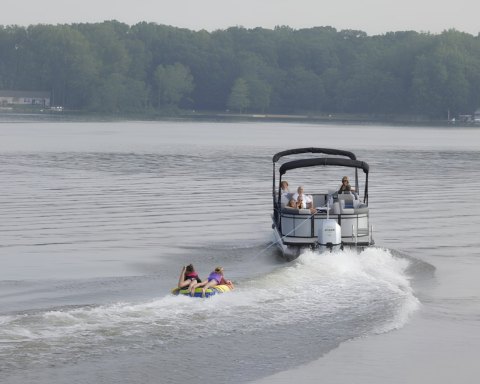
Stand on the dock at Kenosha Harbor on a calm June morning and the lake looks like glass. By two in the afternoon the wind has clocked around to the north, and the water off the breakwall stacks up into a short, steep chop. Every boat coming back through the gap is taking spray. That afternoon is the test people have in mind when they say a pontoon can’t handle the big lake, and the boat they’re picturing is one that mostly doesn’t get sold anymore.
The reputation comes from the old twin-tube pontoons. Two aluminum logs under a flat deck, light, fine for a no-wake bay on an inland lake. Put one of those in a three-foot chop and it pounds, the bow shoves water instead of climbing over it, and it slides sideways through a turn. You came home wet and worn out. If that’s the boat in your head, you’re right to keep it off the lake.
The fix was a third tube. A tritoon runs a center tube under the deck, usually a bit bigger than the two outer ones, and most of what it adds is reserve buoyancy. When the bow meets a wave it lifts over it rather than burying in. Welded along the tubes are lifting strakes, strips of aluminum that give the hull something to bite on, so it holds a line through a turn where the old boats would slide off the top. Tuck spray deflectors under the bow and they knock down the sheet of water that used to come back at you. Add full underskinning across the bottom and the boat runs a touch faster and a good deal drier.
All of that adds weight, and on Lake Michigan weight works in your favor. A heavier boat sits down in the water and gets shoved around less. The other half of it is power. People underpower these boats and then wonder why they wallow. A tritoon wants a real engine behind it. Run a Mercury somewhere in the 150 to 200 range on a family-sized tritoon and it gets up on plane quick and stays there when the water turns lumpy, which is exactly when you want to pick your own speed. Ask what the hull is rated for, and don’t buy the bottom of that number if you run the big lake.
None of this turns a pontoon into a deep-V, and nobody at our docks is going to tell you it does. You still read the weather. When the north wind is up and the chop off the harbor mouth is running three and four feet, you stay in or you work the shoreline, the same call you’d make in a 21-foot bowrider. That part hasn’t changed. What’s changed is the rest of the season, the calm mornings and the steady afternoons, when a good tritoon will run up to Racine or out around Wind Point as dry and settled as most boats its size.
Then there’s the room, which is the real reason to own one. On a Saturday in July you’ve got the kids, somebody’s friends, a cooler, and the dog, and everybody’s sitting down instead of crammed into a cockpit built for four. Drop the anchor off the flats, put the swim ladder down, and the boat turns into a floating dock for the afternoon. A cruiser at the same money holds half the people in half the comfort. For how most families actually spend a day out there, it just fits better.
If you go looking, a few things separate a tritoon that belongs on this lake from one that doesn’t. Bigger tubes, in the 25 to 27 inch range, ride higher and drier than the skinny ones on a budget boat. Look for the handling or performance package, the one that brings the strakes and a full center tube and not a stripped third log just coming along for the ride. Check that it actually has the underskinning and the spray deflectors, not a sticker that says big water. Then run it before you sign, in some chop if you can get it, because no spec sheet tells you what a hull feels like off the breakwall.
The first warm Saturday you load up the family and clear the harbor mouth with the whole crew sitting comfortable and dry, that old line about pontoons stops meaning much. We’ve been selling and servicing boats on the Kenosha lakefront since 1996, and the same people who put you in a SunChaser are the ones who winterize it and pick up the phone when something quits out on the water. Stop in and see us.
