

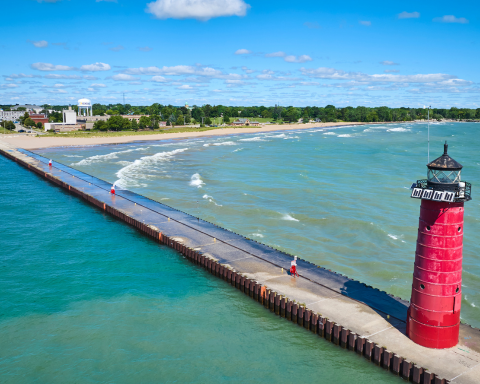
You leave the harbor in the dark. The water in the channel is flat and black, the breakwall light blinking off to your right, and once you clear the gap off Kenosha the lake opens up cold and quiet. Out here in early July the fish have left the beach. The shallows warmed up weeks ago, and the alewives slid out to colder water, taking the kings and cohos with them. So you keep running, watching the graph, until the surface temperature starts to drop and the bait shows up as clouds down below.
In July you’re fishing the temperature break more than a spot on the map. Somewhere down there the warm surface water gives way to cold, and the salmon stack up where it hits the mid-40s, which can be forty feet down or better than a hundred depending on the wind that week. A west wind blows the warm water offshore and stands the fish up shallow. A few days of east wind push it back down deep. You find it with your own graph and temperature probe. Last weekend’s report is already stale.
Once you’re on the fish, the job is covering water until a rod fires. Downriggers carry your spoons and flasher-fly combos down to temperature and hold them there, while Dipsy Divers plane off to the side and work the depths in between. Run a couple of planer boards and you take lines out wide, away from the hull, so your spread covers forty or fifty feet of water rather than a tight cluster behind the transom. Troll slow, somewhere around two to two and a half miles an hour, and hold a steady line until a rod slams down in the holder.
You’ll want a Wisconsin license and a Great Lakes trout and salmon stamp before you leave the dock, and the season’s bag limits are worth a look because they change.
The boat itself surprises people. You don’t need a dedicated sportfisher for this. A used cruiser or a good-sized runabout handles it fine, and plenty of the boats in our slips earn their summers doing exactly that. A 24 to 28 foot Sea Ray or Four Winns, or a solid Bayliner with the I/O, has the cockpit room to work and the freeboard to take a chop on the way home. Rig it with a pair of downriggers, a few rod holders across the transom, a fishfinder that marks bait and reads temperature, and some way to drag the speed down to a troll. That covers most of it.
That last one matters more than people expect. An I/O at idle will often still push a planing hull along too fast to troll, so you slow it down with a trolling bag off the stern, or you hang a small kicker outboard and let the main engine rest. Either way works. And a cold morning is when a cabin earns its money. It can be fifty degrees and spitting rain at five a.m. out there in July, and a cuddy to get out of the wind, with a head aboard, is worth a lot when you’ve got the kids along.
None of this is a knock on the charter fleet. If you fish a couple mornings a summer, hiring a captain out of Kenosha is money well spent, and you’ll likely outfish your buddy who has his own boat but no idea where the break set up that day. But once you’re getting out most weekends, your own rigged boat starts paying for itself, and it goes where you want on your own clock. Run toward Wind Point one morning and stay tight to the Kenosha shoreline the next, and you’re not splitting the catch four ways at the dock.
There’s not much better than running back through the gap by mid-morning, the sun finally up, a cooler of kings in the cockpit and the kids already asking about the beach. The same boat does both. We’ve been selling and servicing boats on the Kenosha lakefront since 1996, and we keep clean used Sea Rays, Four Winns, and Bayliners on the lot that take to this kind of fishing with a little rigging. Come look one over and we’ll walk through what it needs.
