

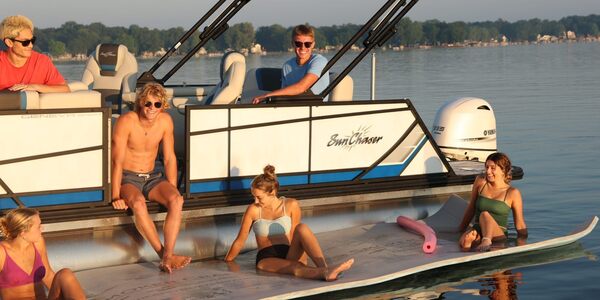
Almost every boat owner privately hopes that when their guests disembark, they will sincerely remark that this was the best day they spent all summer. A high-quality experience of this caliber is never accidental: the successful practices of seasoned boat owners all stem from replicable habits. We have sorted out three core, actionable tips to help you avoid common pitfalls and build a widely praised day on the water.
Start with who, not what.
The single biggest factor in whether a boat day is great is who's on the boat. Not what's in the cooler. Not the destination. Who's on board.
Six people who all know each other and want to be there beats ten people who don't quite mesh. Two couples plus another two couples is usually better than two couples plus three random extra friends. A pontoon holds a lot of people, but the comfortable social capacity of any boat is smaller than the rated capacity, and packing more bodies on doesn't make the day better. It usually makes it worse.
Be willing to keep the guest list smaller than you think. The boat owners who host the best days are honestly a little protective about who gets invited. That's not snobbery. That's just understanding what actually makes the afternoon work.
Clearly assign specific items for each guest to bring, and never use the vague request of "just bring a little something". Boat owners can take charge of providing ice and all supplies that need refrigeration throughout the day, while the rest of the guests can be assigned separately to prepare the main meal, drinks, and desserts. This arrangement completely avoids the chaos of duplicate or missing supplies.
While you're at it, tell people what to wear. Swimsuits obviously. But also that the boat has shade but not enough for everyone, so a hat is a real idea. That the water out on Lake Michigan is colder than the day suggests, so a long-sleeve layer matters. That bare feet are easier than flip-flops once you're on the boat. These small communications save people from the small miseries that ruin afternoons.
Here's a thing nobody tells you about boat food. Sandwiches you can eat with one hand always beat sandwiches you can't. Wraps and subs travel well. Anything that needs a fork and a plate becomes a balance problem on a moving boat. Charcuterie boards photograph beautifully and turn into a sliding mess the moment a wake comes through.
Pre-portion things. Individual bags of chips beat a big bowl. Small water bottles beat a gallon jug that gets warm. Cookies in a sealed container beat cake that needs to be cut. The whole principle is to minimize what has to be assembled, cut, served, or fussed with once you're underway.
Bring more water than you think. Always. Twice as much as you think you need. People on boats dehydrate faster than they realize, and the day goes sideways much faster when somebody's headache becomes the focus of everyone's attention.
You want to be the boat people enjoy hearing in the distance. You don't want to be the boat people complain about at the marina.
Volume matters more than playlist. A reasonable volume that lets people talk over it is the right volume. Pontoon stereos can get genuinely loud, and there's a temptation to use that capability. Resist it. Music is the background of a great day, not the main event. If people have to lean in close to hear each other, the music is too loud.
The other thing is that sound carries over water in ways it doesn't over land. The volume that sounds normal on your boat sounds aggressive from the boat anchored fifty yards away. Be a good neighbor at the sandbar. The pontoon community on Lake Michigan and the inland lakes is genuinely friendly, and most of the friction that does happen comes from one or two boats being inconsiderate about volume.
For sun protection and trip planning, note that ultraviolet radiation on the water is far stronger than it is on land. The fixed standard canopy that comes factory-equipped on most pontoon boats cannot adjust to the sun’s changing position. Arrange for swiveling seats so guests can move into shade whenever they need, bring an extra umbrella if you have empty space on your boat, and keep sunscreen within easy reach. Proactively remind guests who come from out of state, or who rarely ride on boats, to reapply sunscreen.
Sunset is part of this too. The light at six or seven in the evening is honestly the best part of a boat day, and a lot of hosts cut the day short before the best part happens. Plan to be out for the sunset, not back at the slip before it.
Rafting up with another boat or two is one of the great social moves on the water. It's also a skill that takes a little practice.
The principle is that one boat sets the anchor, and other boats tie off to that boat with bumpers between hulls. The anchor boat needs to be the largest or the one with the most appropriate ground tackle for the conditions. Coordinate before you get there, not during the actual rafting. Trying to figure out who's anchoring while wind pushes everybody around at five miles an hour is a recipe for scratched gel coat and short tempers.
Have bumpers ready. Lots of them. More than you think. Pontoon-to-pontoon contact without bumpers leaves marks on rub rails that show up for the rest of the season.
And don't overstay. Two hours rafted up is usually about right. Three hours and people start getting restless. The host who reads the room and makes the move to break up the raft at the right moment is the host people remember as having the perfect timing.
The first ten minutes and the last ten minutes of a boat day are where most of the small problems happen. People don't know where to step. People don't know what to do with their bags. People bring coolers that are too big to fit comfortably.
Set up before guests arrive. Have a clear spot for shoes, a clear spot for bags, a clear spot for the cooler they're bringing. Show them where the head is. Show them where the cold water is. Spend two minutes at the start being a genuine host instead of just letting people figure it out.
The same thing on the way back. Help with bags coming off. Make sure nobody's leaving a phone or a sweatshirt behind. Walk them up to the parking lot if they're not familiar with the marina. These small touches at the bookends of the day are what make the difference between a good time and a memorable one.
A great boat day is mostly about being unhurried.
If you're rushing, your guests feel it. If you're stressed about timing, your guests feel that too. The host who's calm and easy is the host whose days feel like the days everyone wants to be invited back to.
This means leaving a little earlier than you'd planned. Padding the schedule. Not trying to hit four destinations when one or two would work better. The best boat days aren't packed full of activity. They're long, slow, lazy, full of conversation and swimming and small moments that aren't really about anything.
That's the real proposition of pontoon ownership, after all. Not the boat itself. The afternoons the boat makes possible.
Build a few of those into your summer. Invite the right people. Keep the music reasonable, the cooler full, the schedule loose. The compliment at the end of the day will follow.
